
A Foot in the (car) door. Car telemetry privacy.

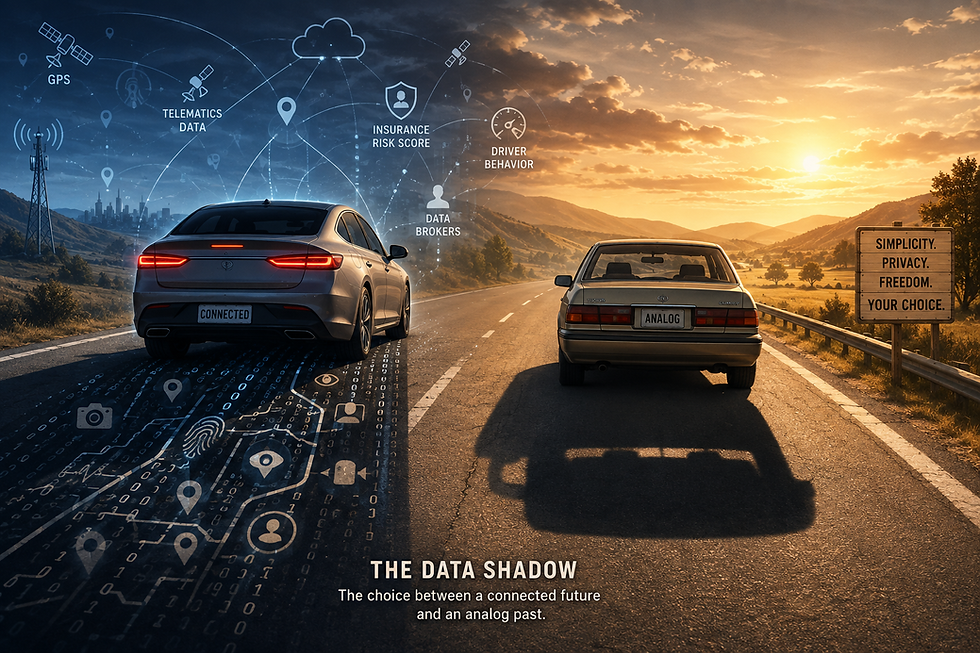
Tucked inside a massive federal spending bill at the height of COVID, disguised as an “essential jobs package” amid the lockdowns and layoffs, was a mandate that has the ability to transform the automotive new and used car market. In the days ahead, we may see a shift in vehicle pricing, organic market movement away from new vehicles to pre-owned late-model pre-IIJA (Infrastructure Investment and Jobs Act) vehicles once the full scope of the implemented technology is understood and full consumer car telemetry privacy fatigue sets in.
The Legislative Trojan Horse
Late in 2021, Congress passed the Infrastructure Investment and Jobs Act. Embedded deep within this must-pass trillion-dollar spending bill lay a section titled “Advanced Drunk and Impaired Driving Prevention Technology.” A section never debated or scrutinized individually; instead, it bypassed all single-issue committee oversight or floor debate before its passage. This statute directs the National Highway Traffic Safety Administration (NHTSA) to issue rules that require all new passenger motor vehicles to be equipped with technology that passively and continuously monitors driving behavior or blood alcohol concentration (BAC). Should this technology detect impairment, or at least what its algorithm perceives as impairment, the vehicle must limit motor vehicle operation.
Potential Market Reaction: Already, we are witnessing the more industrious among us ready to seize upon this opportunity by marketing their used cars as “Pre-2027 Kill Switch Vehicles.” While clearly ahead of this technology’s current capability or legislative application, the idea has taken root. Perhaps these are early indications of where we are headed, whether it is a consumer revolt that reshapes the market or industry role players capitalizing on the fears of buyers.
Reliable, relevant, and recent polling has proven consumer distrust over connected vehicle telemetry is accelerating alongside sharp, market wide depreciation for software dependent models. Investigations by the Federal Trade Commission highlight that connected cars routinely harvest sensitive location, behavioral, and biometric data, often shared with data brokers and insurers which Fortune Business Insights identifies as a primary driver of growing consumer skepticism. Furthermore, a J.D. Power UBI Survey revealed that only 22% of drivers feel comfortable with “continuous telematics” tracking, citing privacy risks, fear of rate hikes, and general corporate distrust as main barriers to new vehicle purchase.
As software loaded luxury and electric vehicles face steep tech obsolescence, often losing over 40% to 70% of their resale value within five years, secondary market data suggests that simple, “analog” performance cars maintain or even gain value better than almost any other segment due to lower long term repair costs, freedom from subscription paywalls, and superior privacy controls.
While new car sales won’t collapse under tech privacy concerns anytime soon, as many Americans prioritize convenience over control, Apple CarPlay and smartphone integration over data privacy, expect the creation of a robust secondary “analog” market, consisting of 2015–2025 vehicles manufactured prior to mass surveillance integration. For those opposed to being spied on, expect to maintain your vehicles longer and pay more to insure your car.


Comments